


From Enrichment to Action: How Security Teams Operationalize IP Intelligence

Get Unlimited Access to IPinfo Lite
Start using accurate IP data for cybersecurity, compliance, and personalization—no limits, no cost.
Sign up for freeI often tell the security teams I'm working with that quality IP data can move their decision-making from reactive to proactive.
Time and time again I’ve seen that the organizations getting the most value from IP intelligence are using it before a security event escalates, incorporating it throughout the security lifecycle.
In conversations with security teams, I hear three themes repeatedly. First, analysts need better ways to prioritize the events that deserve immediate attention. Second, organizations want intelligence available earlier in the workflow rather than only during investigations. And third, teams need confidence that the data informing their decisions accurately reflects how internet infrastructure behaves today. Those challenges shape how mature organizations operationalize IP intelligence across their environments.
This shift from enrichment to action is changing how security teams operationalize IP intelligence.
Context Matters Before Investigation
Security operations centers process thousands of events every day. Alerts arrive from a multitude of sources. Each source contributes valuable information, but context is often fragmented across multiple tools.
Analysts are constantly making decisions about which events deserve attention, which can be safely deprioritized, and which require immediate action. One of the most common challenges I hear from customers is the sheer volume of alerts competing for analyst attention. When every event arrives with limited context, prioritization becomes increasingly difficult.
This is where IP intelligence often provides its first operational benefit. Location, network ownership, hosting infrastructure, and privacy signals help analysts understand what they're looking at before they begin a deeper investigation.
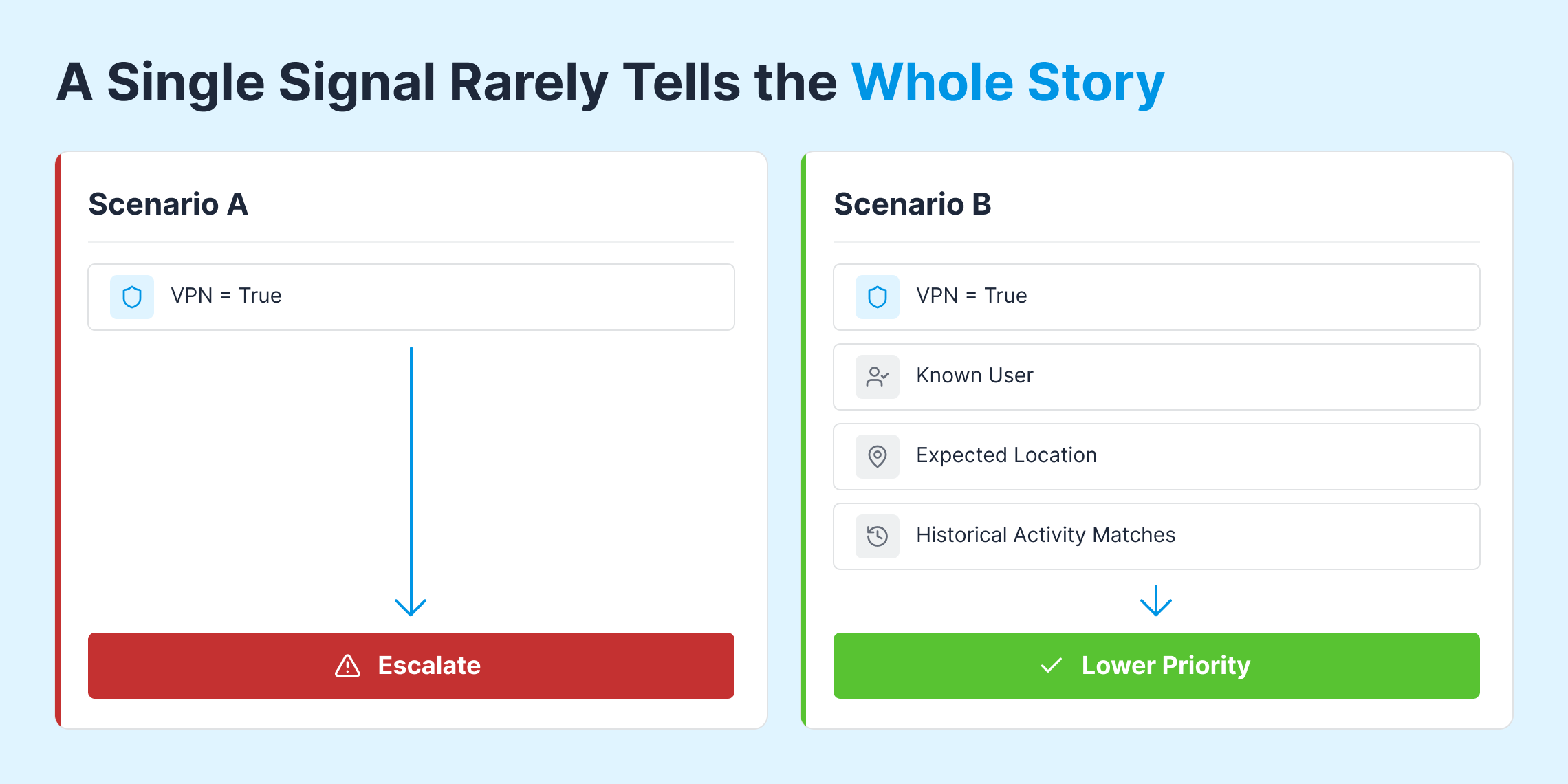
How Security Teams Combine Signals
I’ve observed a shift away from using IP intelligence only during investigations. Increasingly, teams are enriching events as they enter SIEMs, detection pipelines, and automated workflows. The goal is simple: provide context as early as possible so analysts spend less time gathering information and more time making decisions.
The most effective security workflows build context from multiple layers of information.
Location Context
Geolocation often provides the starting point for an investigation.
Useful signals include:
- Country
- Region
- City
- Accuracy radius
- Geolocation confidence
These signals support impossible travel investigations, account access reviews, and compliance workflows.
Geolocation can serve as an early source of context, but location alone rarely tells the entire story.
Network Context
Network ownership frequently explains how traffic should be interpreted. IPinfo data categorizes ASN ownership into five categories: ISP, hosting, government, education, or business. These attributes help analysts distinguish between very different types of traffic.
Privacy Context
Anonymization infrastructure continues to grow in complexity. Beyond VPNs, there are also Tor, relay services,datacenter proxies, and now residential proxies.
In our research, we found that 46% of residential proxy IPs appeared across multiple provider networks simultaneously. We also observed millions of IPs rotating in and out of proxy infrastructure over relatively short periods. Those findings illustrate why recency and persistence can be valuable signals during investigations.
Rather than treating anonymization as a binary classification, mature teams use these signals to better understand how an IP is being used.
Internal Context
IP intelligence becomes even more valuable when combined with internal telemetry:
- User history
- Device signals
- Authentication events
- Transaction activity
- Endpoint telemetry
Layering Internal Context with IP Intelligence
IP intelligence becomes even more valuable when combined with your own internal telemetry. Many security focused teams use our IP data as a foundational signal, but understanding the nature of your traffic is what helps complete the full picture.
- User history
- Device signals
- Authentication events
- Transaction activity
- Endpoint telemetry
- Session behavior
- Billing/shipping address consistency
Together, these sources create a more complete picture of activity and support more consistent decision-making.
The Decision Points That Matter Most
IP intelligence creates operational value at several key points throughout the security workflow.
During Alert Triage
Triage is fundamentally a prioritization exercise.
Analysts need to quickly determine whether an alert deserves deeper investigation and what context is available to support that decision.
IP intelligence helps answer questions such as:
- Is the infrastructure familiar?
- Is anonymization involved?
- Does the location align with expectations?
This stage is where many teams realize the value of operationalized IP intelligence. Rather than requiring analysts to manually gather context from multiple sources, enrichment provides critical information immediately. That allows teams to focus their attention where it matters most and reduce time spent investigating routine activity.
During Investigation
Once an event moves into investigation, analysts need a deeper understanding of the infrastructure involved.
Questions often include:
- Who owns this network?
- Is this hosting infrastructure?
- Is this a residential proxy?
- Has the location recently changed?
- What surrounding evidence supports this activity?
This is where detailed attribution and supporting evidence become especially valuable.
At IPinfo, investigators move faster when they can inspect the signals behind a classification rather than relying on a simple label.
Another recurring theme in customer conversations is trust. Analysts need confidence that the information they're seeing reflects current internet conditions. When enrichment data becomes stale or inconsistent, investigation time increases because teams must validate findings independently before taking action.
During Automated Detection and Response
Many security teams incorporate IP intelligence directly into detection rules, enrichment pipelines, and automated workflows.
Signals such as hosting infrastructure, anonymization services, ASN ownership, and geographic context help improve prioritization and routing decisions throughout the pipeline.
The result is a workflow where analysts can focus on higher-value investigations while automation handles repetitive enrichment tasks.
Common Failure Modes
Even mature security programs encounter challenges when operationalizing IP intelligence.
Treating Signals as Binary Outcomes
Security decisions are strongest when multiple forms of evidence contribute to the outcome.
VPN usage, hosting infrastructure, or geographic anomalies each provide useful context. Together, they provide a much richer understanding of what's happening.
Using Data That Doesn't Reflect Current Internet Conditions
One challenges in measuring the internet is how quickly infrastructure changes.
IP addresses move between networks. VPN providers expand into new address space. Residential proxy infrastructure evolves continuously. Ownership records, routing information, and observed behavior can all change over time.
I regularly hear from customers that data quality directly affects operational outcomes. Inaccurate location data creates false positives. Missing proxy detections reduce visibility. Outdated infrastructure information slows investigations.
Effective security workflows depend on intelligence that continuously reflects how the internet behaves in practice.
Relying on a Single Source of Evidence
Every source provides a different perspective on internet infrastructure.
Public records can indicate ownership. Routing data reveals how traffic moves across networks. Active measurements show how infrastructure behaves in practice. Direct provider verification can confirm how anonymization services are operating today.
At IPinfo, we combine these forms of evidence rather than relying on any single source. Our data is informed by internet-wide measurements from ProbeNet, IPinfo's internet measurement platform, alongside routing information, public records, direct provider observations, and continuous validation by our research and engineering teams.
The result is a more complete view of how an IP address is actually being used.
Hiding Confidence Information
Customers’ confidence in the information they’re basing decisions on is often just as important as the signal itself.
An analyst investigating suspicious activity benefits from understanding not only where an IP appears to be located, but also how precise that estimate is, when it last changed, and what evidence supports it.
Supporting context such as accuracy radius, provider attribution, data provenance, and infrastructure history helps teams evaluate findings more effectively and make decisions with greater confidence.
What "Good" Looks Like Operationally
The most effective security teams integrate IP intelligence directly into the workflows where decisions are made.
Across customer conversations, the organizations getting the most value from IP intelligence share a common goal: reducing uncertainty. They want analysts to spend less time gathering context, less time validating data, and more time making informed decisions. They:
- Enrich security events automatically rather than relying on manual lookups.
- Combine location, network, privacy, and internal telemetry to create a fuller picture of activity.
- Provide analysts with supporting evidence that helps explain why an event deserves attention.
- Continuously refresh the intelligence that powers detections, investigations, and response workflows.
Most importantly, they use IP intelligence to reduce uncertainty at key decision points throughout the security lifecycle.
Every security workflow ultimately depends on understanding what an IP address represents at a specific moment in time. The challenge is that internet infrastructure evolves continuously.
That's why the most effective security teams increasingly rely on evidence-backed, continuously refreshed IP intelligence throughout their detections, investigations, and response workflows.
When analysts can see the context behind an event, and understand the evidence supporting it, they can prioritize more effectively, investigate more efficiently, and act with greater confidence.
Share this article


About the author

Kevin is the founding Account Manager at IPinfo, where he works closely with enterprise security and fraud teams on the front lines of proxy and VPN detection.